
Franklin County Jail Release Paths
The Franklin County Sheriff’s Office operates one combined jail and house of correction at Elm Street. The jail function covers people awaiting trial. The house-of-correction function covers men and women serving terms of no more than two and one-half years. These are two roles of the same institution, not separate facilities. A pretrial release may follow bail, personal recognizance, dismissal, a court order, or time served. A sentenced release may follow sentence expiration, parole where eligible, probation, or another lawful discharge.
The word “release” needs close reading. Massachusetts records also use it for transfer to another criminal-justice agency, expiration to a warrant, parole to a detainer, or the end of one legal status while confinement continues. A person may therefore leave Franklin County sheriff custody without entering the community. The admission and release report should identify the release category and the receiving authority or destination. Those two fields explain whether the next step was home, supervision, MA DOC, another county, federal custody, or immigration custody.
Confirm Franklin County Jail Release
Franklin County has no official public name roster, former-inmate archive, or recent-release feed. The sheriff’s records unit is the direct route. Begin with the main line when the question is urgent, then seek the underlying record when the result must be documented. The broader Franklin County released inmate search explains how to continue across court, state, federal, and supervision systems when the disposition points beyond Elm Street.
- Call the Franklin County Sheriff’s Office at 413-774-4014. Give the full name and enough identifying detail to avoid a mistaken match. Ask whether the person remains at Elm Street.
- If the person is no longer held, ask whether FCSO recorded a community release or a transfer. Request the effective release date and time, category, and receiving authority.
- Send a focused request to the FCSO Records Access Officer. Name the existing admission and release report or booking-file pages instead of asking staff to create a new summary.
- Check the issuing court docket for bail, recognizance, dismissal, sentence, time served, probation, warrant, or later case activity. A court order proves legal authority, while the FCSO report records when physical sheriff custody ended.
- Follow any transfer. Use MA DOC records for a state commitment, the receiving county for a county transfer, and the relevant federal or immigration channel when the report names that authority.
Dates from different records should not be merged. A court docket time may mark authorization. The FCSO time marks the end of sheriff custody. A calculated state release date can be prospective, while an actual release field describes an event that occurred. Label each date with its source.
Note: Massachusetts VINE covers participating MA DOC records, not a person held solely by the Franklin County Sheriff’s Office.
Franklin County Jail Records Contact
The sheriff’s records officer handles the county admission and release report, booking-file portions, sentence-calculation material held by FCSO, and separately identified booking-photo requests. Police reports stay with the arresting department. Court records stay with the Trial Court. One sheriff request will not pull those separate files.
Franklin County Sheriff’s Office
Records Access Officer
ATTN: Records/Capt. Jason Yuryan
160 Elm Street
Greenfield, MA 01301
Email: records@fcso-ma.us
Phone: 413-774-4014 ext. 2191
Administrative hours: Monday through Friday, 9 a.m. to 5 p.m.
A useful request supplies the full name, date of birth if known, booking or commitment number if known, and a narrow date range. Ask for the booking number, admission date and time, actual end of FCSO custody, release type, releasing facility, court or docket, destination, receiving authority, and any existing sentence-calculation sheet or discharge certificate. Exempt portions may be redacted. The office does not have to create a report that does not already exist.
Massachusetts public-record law generally calls for a written response within ten business days. It also permits estimates, lawful redactions, and reasonable fees under stated conditions. FCSO has not posted a fixed fee for a release record or photograph, so the records officer must provide the actual estimate.
Franklin County Jail Custody Scope
The FCSO Facility Operations page gives unusual detail about the records unit. Staff maintain committed-person files, mittimuses, writs, police and probation reports, classification files, and registry or victim-notification material. A mittimus is the court document that commits a person to custody. The unit also computes sentences and earned credits, processes warrants and summonses, and prepares admission and release reports. That published duty is the basis for requesting an existing release report even though no public roster is online.
- Recognizance
- A court-authorized release based on a promise to return, without posting cash bail.
- Discharge
- The legal end of a sentence or custody status, which may differ from a transfer.
- Detainer
- A hold or request from another authority that can prevent immediate community release.
- Receiving authority
- The agency that takes custody after FCSO records its own release or transfer event.
Kimball House appears in sheriff property rules as a pre-release unit. The public material gives it no separate address, records officer, locator, or release database. Movement to that unit should be treated as an internal placement unless the final FCSO transaction says legal custody ended. The same records and court chain applies to a later community release.
Franklin County Jail Release Property
Property handling provides a separate clue but does not prove release. FCSO inventories property at admission. A person in custody may complete a property-release form that permits an adult friend or family member to collect stored items. One set of clothes remains for the person’s eventual release or transfer. Large property may still be held by the arresting police agency, so a missing item may never have entered the sheriff’s inventory.
The sheriff publishes the exact identification and pickup rules on its inmate property page.
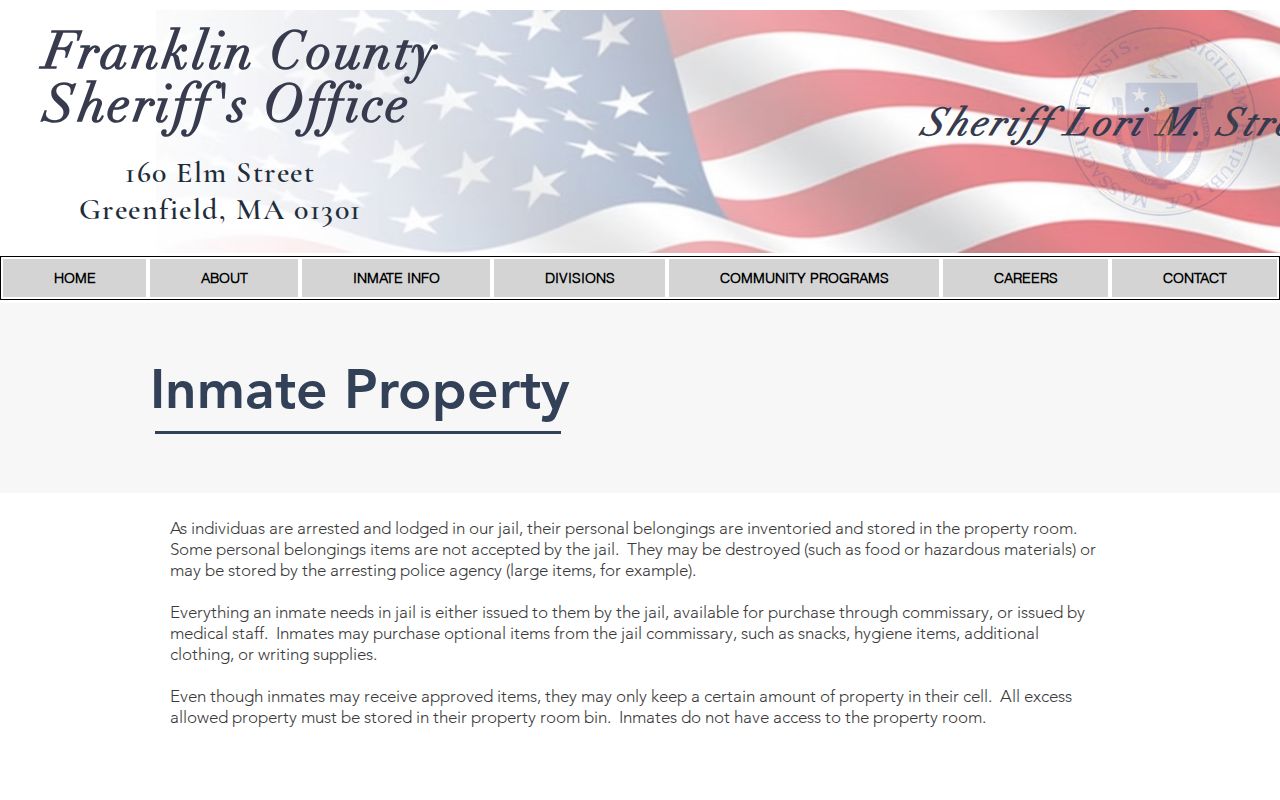
The captured page confirms that the adult picking up processed property must present official photo identification and use the jail lobby. It also shows why property pickup and legal release must be checked as two different events.
Special Kimball House property drops require advance approval by the unit manager and are accepted on weekdays during the published daytime window. That rule concerns property going into a pre-release unit. It does not establish that the person has left custody.
Note: Keep the property receipt and release record separate because each answers a different question about the Franklin County jail stay.
Franklin County Jail Release Fields
A complete record request should target fields that distinguish community release from continued confinement. The office may use different labels, and some material may be withheld, but naming the desired existing data helps the custodian find a segregable public portion.
| Requested field | What it helps establish |
|---|---|
| Actual release date and time | When Franklin County sheriff custody physically ended |
| Release category | Bail, recognizance, time served, expiration, parole, probation, court release, or transfer |
| Releasing facility | Whether the transaction came from Elm Street or another custodian |
| Destination or receiving authority | Whether the person entered the community or remained confined elsewhere |
| Court and docket | The case record to check for the order, sentence, or later change |
| Sentence computation | The credited time and calculation behind a sentenced discharge |
Retention is not stated on the sheriff’s public pages. Ask the Records Access Officer which schedule applies to the requested report. Sealing or expungement can restrict what a court or criminal-history system discloses, but the effect depends on the order and the record holder.
Franklin County Jail ICE Transfers
Franklin County’s former ICE detention operation closed in 2021. Contemporary reporting on the closure states that the last nine immigration detainees were transferred to Plymouth County. That local history does not show the current status of any person, but it demonstrates why disappearance from Franklin custody cannot be read as proof of community release.
If a current FCSO disposition names immigration authorities, first confirm the date, category, and receiving agency in the sheriff record. Then use the ICE Online Detainee Locator System for present custody or a recent ICE release within its limited window. An ICE detainer is a hold request, not proof that the person entered ICE custody. The transfer must appear in the actual disposition.
The same logic applies to other receiving systems. MA DOC, another sheriff, BOP, or the U.S. Marshals Service maintains its own record. A community release should be stated as such. A transfer should remain labeled a transfer until the next custodian confirms what happened.
Franklin County Jail Court Check
Greenfield District Court, Orange District Court, and Franklin County Superior Court can each hold part of a Franklin release trail. The correct court depends on the charge, location, and case level. Use the official Massachusetts court-search route for public case access, then contact the clerk when the docket number is unknown or a document is unclear.
Look for bail or recognizance orders, dismissal, plea, sentence, time served, probation, warrants, stays, revocations, and later case events. A court disposition may establish the legal reason for release. It may not contain the moment a person walked out or transferred. The FCSO report remains the better source for that physical custody event.