
Franklin County Parole Versus Probation
Parole begins with a custodial sentence. The Massachusetts Parole Board may allow a person to serve the rest of that term in the community under stated conditions. Probation is imposed by a judge and administered by Massachusetts Probation Service. It can follow jail, overlap with another case, or exist without a prior prison release. The Franklin County release record and court judgment show which path applies.
| Question | Parole | Probation |
|---|---|---|
| Who orders or grants it? | Massachusetts Parole Board | Sentencing court |
| What does it follow? | Release from a custodial sentence | A court sentence, with or without custody first |
| Best starting proof | Release disposition, permit, and board record | Docket, judgment, and probation order |
| Public name locator? | No comprehensive statewide parolee search | No public real-time compliance search |
| How does it end? | Maximum date or earlier Board termination | Court or supervision discharge process |
- Supervision
- Rules and reporting duties that continue in the community after a release or sentence.
- Absconder
- A supervised person alleged to have left contact or control without permission.
- Revocation
- A formal action that can cancel community status and lead to renewed custody.
- Discharge
- The documented end of a custodial term or supervision obligation.
Verify Franklin County Release Supervision
No single public screen reports every Franklin County parole or probation status. Build the answer from the release record, court case, and supervising agency. A life-sentence decision or scheduled hearing may add context, but it cannot replace proof that the person physically left custody.
- Request the FCSO admission/release report when the person left the Franklin County Jail and House of Correction. Read the disposition for parole, probation, transfer, or another release type.
- Check the sentencing docket. Look for the sentence, probation order, term, later violations, warrants, revocation, and discharge entries.
- If the record says parole, identify the Massachusetts Parole Board document or assigned office. Use published decisions only for the case types the Board actually posts.
- If the record says probation, contact the probation office attached to the sentencing court. A probationer or authorized person may have access that a member of the public does not.
- Confirm the current status through the proper record. An old release date does not resolve a later warrant, revocation, new case, or completed supervision term.
The state's access rules explain why a concerned friend or relative may not receive a live probation report. The official probation information page says adult status generally cannot be discussed with family, a spouse, neighbors, friends, or other members of the public without the required signed release.
The state page shows the public and authorized access boundary.
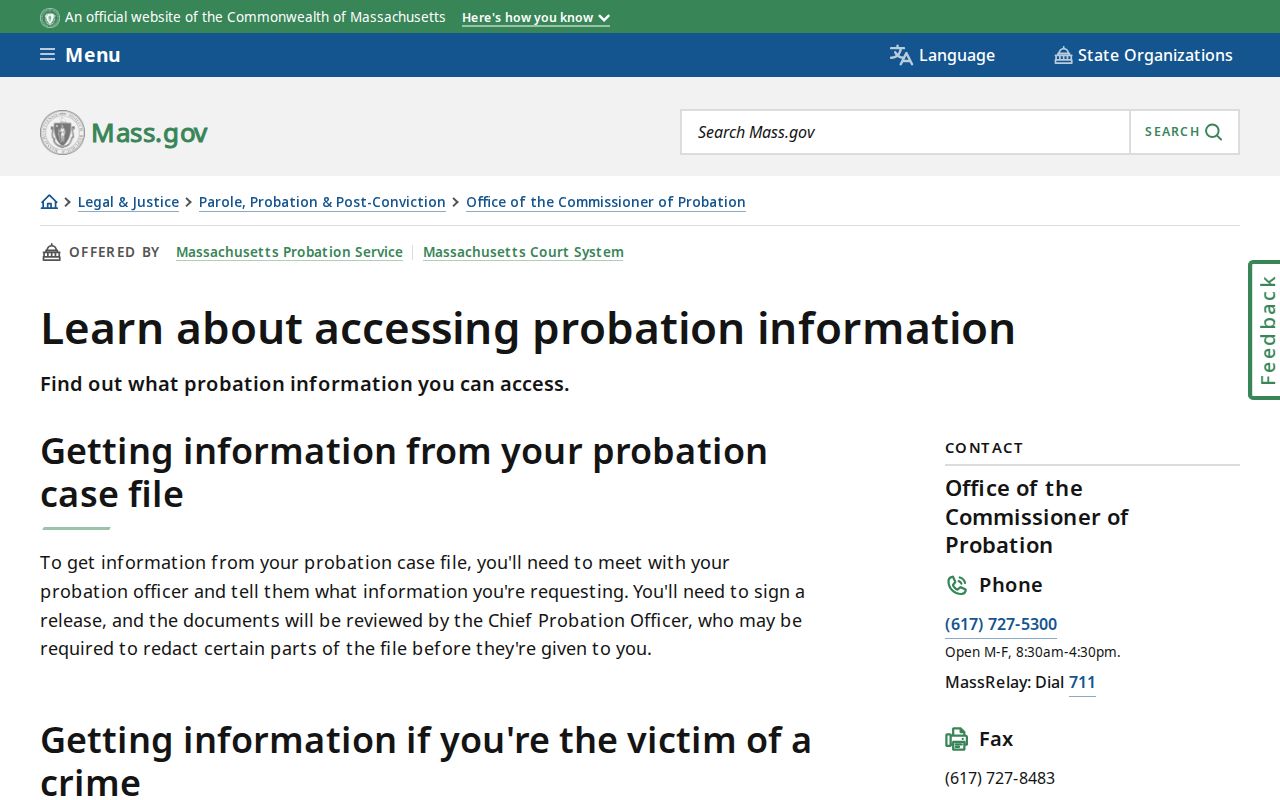
The image supports using the docket for public facts and the assigned officer for authorized file access.
Franklin County Parole Release Records
The Massachusetts Parole Board does not provide a full parolee-by-name locator. A current or former parolee can request their own file. A third party generally needs a specific request and a completed Third Party Authorization/CORI Release. Public-record requests go to par.rao@state.ma.us, subject to privacy and other exemptions.
Massachusetts Parole Board
12 Mercer Road
Natick, MA 01760
508-650-4500 or 866-480-6272
Public records: par.rao@state.ma.us
The May 2026 Transitional Services Directory lists an institutional parole contact at the Franklin County House of Correction, 160 Elm Street. That contact serves the institutional stage. It is not a general public desk for tracking a person after release. Field supervision moves to an assigned regional office shown on the release papers.
Region 5 is at 436 Dwight Street in Springfield, with a listed phone of 413-784-1210 and weekday hours of 9 a.m. to 5 p.m. Its location page does not explicitly assign Franklin County to that region. Confirm the actual field office through the permit or central Board staff instead of assuming from geography.
Franklin County Probation Court Contacts
Probation remains tied to the sentencing court. Franklin County has three local routes. Greenfield District Court serves its listed central and western towns. Orange District Court serves eight eastern-area communities. Franklin County Superior Court handles applicable higher-level criminal matters countywide. Remote criminal access is generally by exact docket number, while courthouse public terminals allow broader searches of non-excluded records.
| Sentencing court | Probation contact | Hours |
|---|---|---|
| Greenfield District Court, 43 Hope Street | 413-774-5531 | Weekdays, 8:30 a.m.–4:30 p.m. |
| Orange District Court, 1 Court Square | 978-544-8281 | Weekdays, 8:30 a.m.–4:30 p.m. |
| Franklin County Superior Court, 43 Hope Street | 413-773-7249 | Weekdays, 8:30 a.m.–4:30 p.m. |
These numbers route a probationer or authorized person. For public confirmation, use the clerk's docket and disposition. A term stated in the judgment shows what the court ordered, but not necessarily whether every condition is current or whether the person has completed discharge.
Franklin Parole Hearings and Release
Ordinary institutional parole hearings are closed to the public, and no statewide calendar lists every candidate. The public Life Sentence Hearing Calendar contains monthly files for a limited category. The Records of Decision collection publishes name-indexed decisions for life cases. A decision can give the hearing date, result, reasons, and conditions, with confidential parts removed where required.
The public calendar's structure is visible in the official capture.
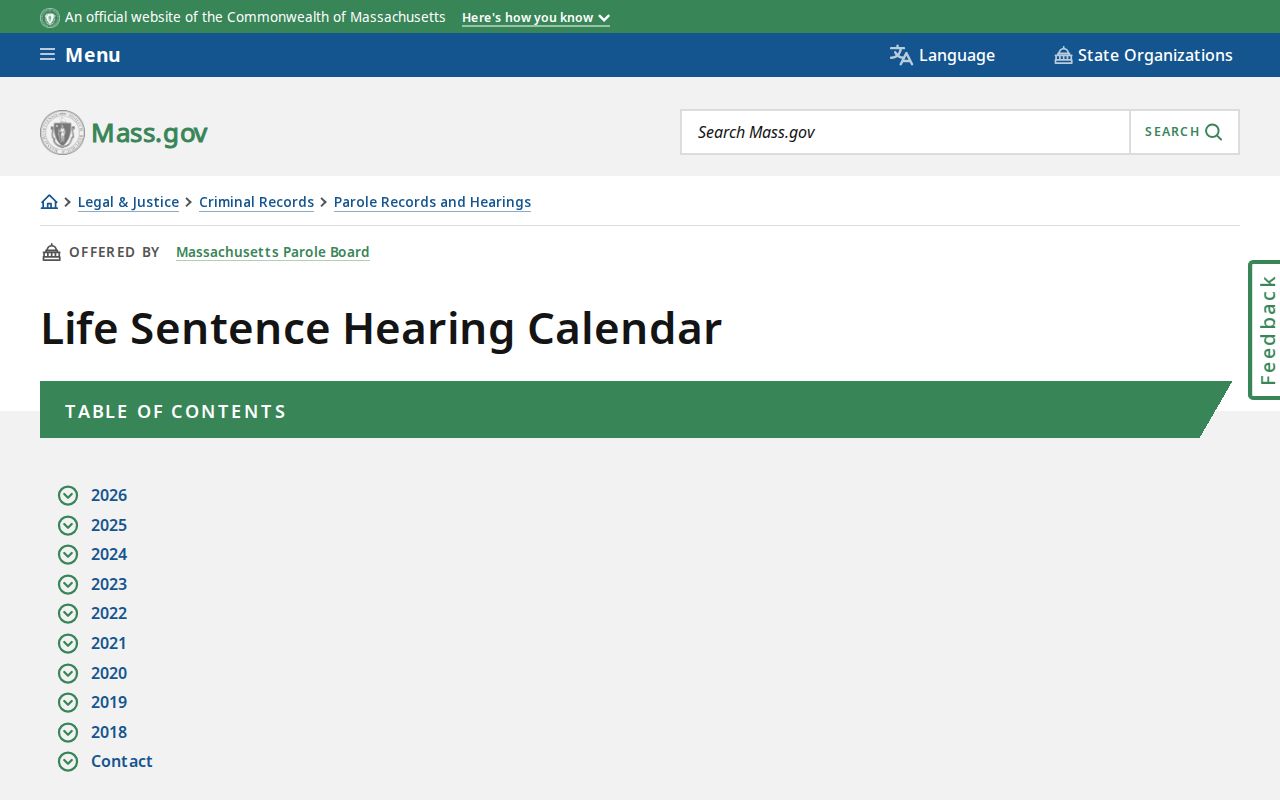
That monthly calendar is not an all-parole lookup and does not prove that a named person left an institution.
A grant can be rescinded before release. Home-plan review, conditions, warrants, detainers, and a final permit still stand between eligibility and departure. Termination-request hearings concern ending supervision early after release. They do not establish the original jail release date.
Eligibility is another distinct point. For a qualifying house-of-correction aggregate term of at least sixty days, the general rule uses one-half of the aggregate term or two years, whichever is shorter, subject to any longer mandatory minimum. A state-prison term follows the court-set minimum and eligible earned credits under the governing statutes. Eligibility only marks when the Board may consider release. It is not a scheduled exit, a favorable vote, or a discharge from later supervision.
Franklin Release Warrants and Absconders
A violation may lead to a warrant and renewed custody. The Board's Warrant Apprehension Unit accepts information about a wanted parolee at 617-376-6269. Massachusetts State Police dispatch is 508-820-2121. The official wanted-parolee route is for tips. It is not a complete public list of every absconder or warrant.
The official tip route makes that limited purpose clear.
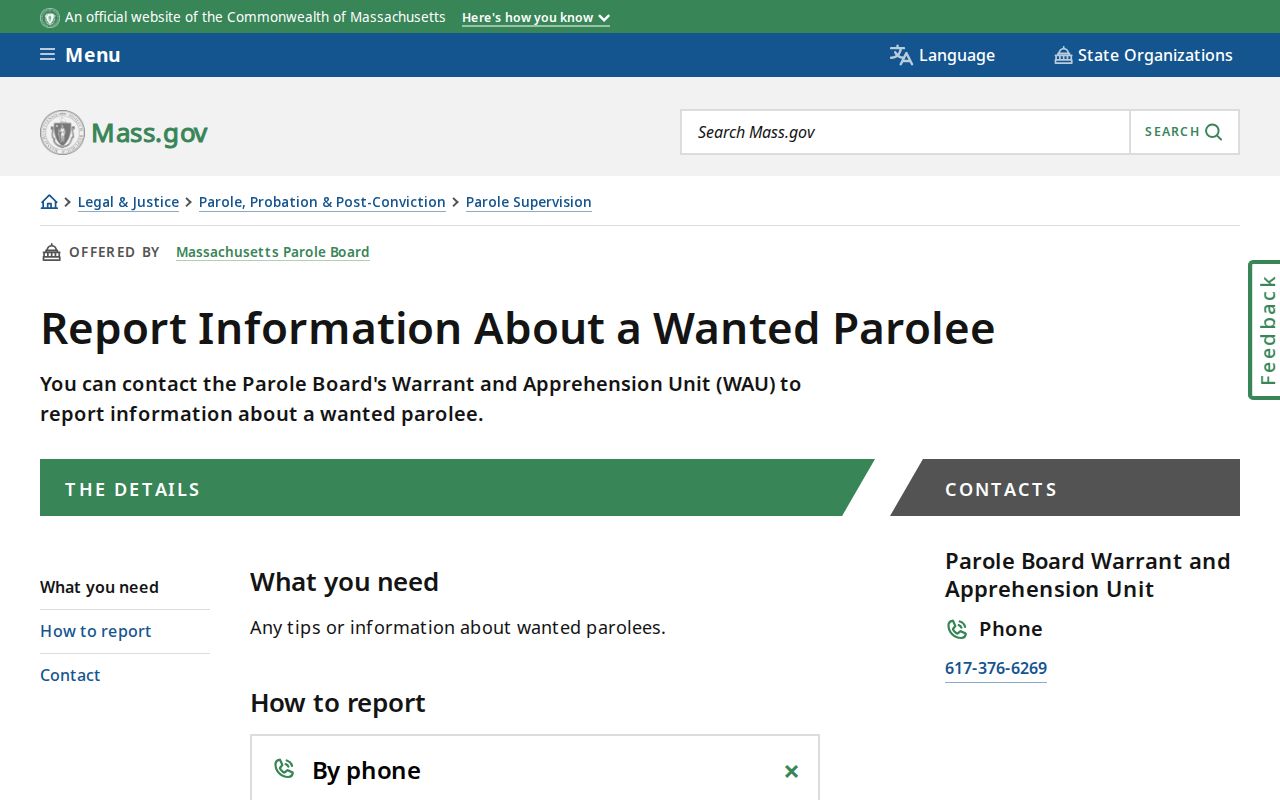
An absent name on a selective page does not prove clean status. Use the court docket, authorized supervision file, and current custody record for the specific person.
Common supervision conditions may address reporting, residence, travel, treatment, and compliance with law. The actual permit or probation order controls. A high-level summary cannot establish a violation. Revocation also requires its own process and record.
Franklin Reentry During Release Supervision
FCSO operates a named reentry program for Franklin County residents returning after incarceration. Its dedicated Franklin County Reentry Services site identifies a downtown Greenfield location at 106 Main Street and a first-ten-days resource. Support includes identification documents, transportation planning, treatment and health connections, education, and basic-needs navigation.
The local program can support compliance and practical planning, but it is not the parole or probation authority. A ride, referral, or appointment does not alter a reporting condition. The person should carry release papers and contact the assigned supervision office when those instructions are unclear.
The local service and transportation focus appears on the program site.
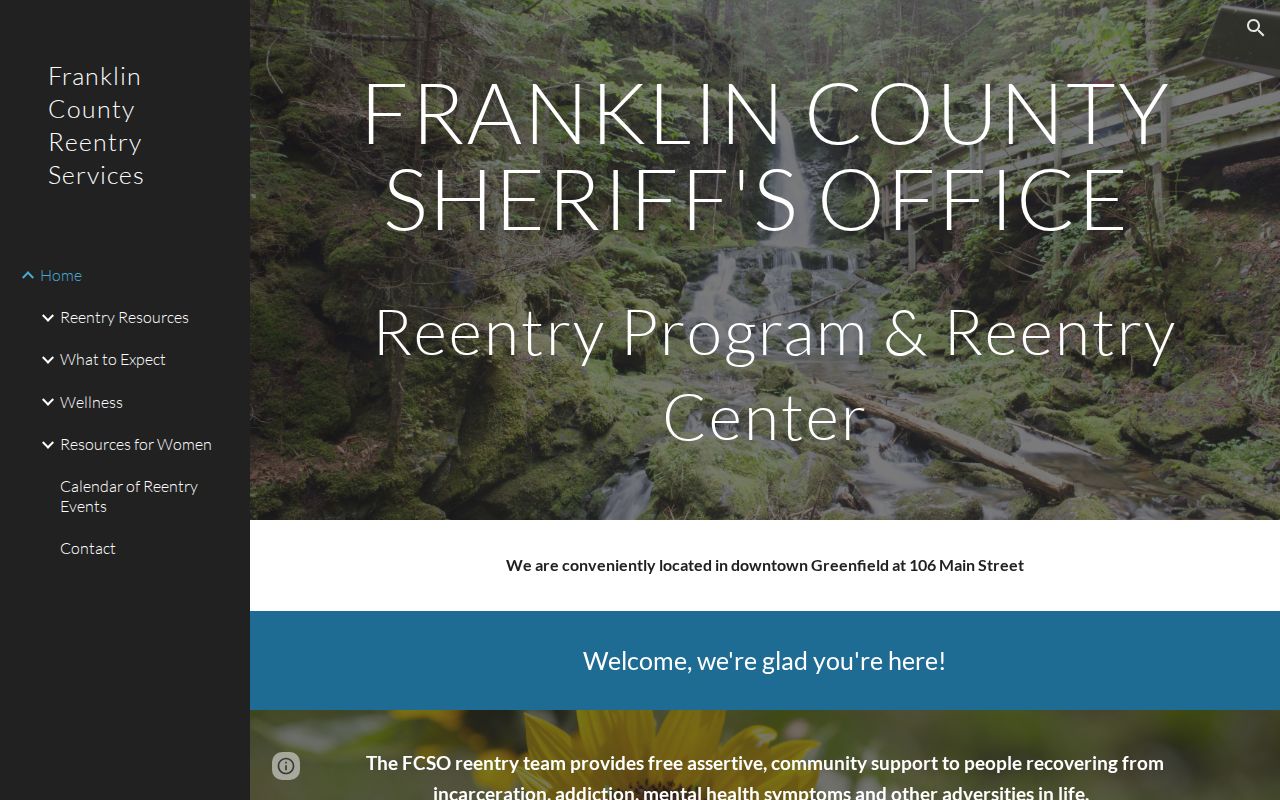
The resource helps with the first days after release without serving as proof of supervision status.
Franklin Property Before Supervised Release
FCSO's property procedure can matter before a parole or probation release. An incarcerated person may sign a form authorizing an adult friend or family member with official photo identification to collect stored property. One set of clothing stays for the eventual release or transfer. Large property may remain with the arresting police department.
Property pickup and release are separate events. The signed form does not prove that supervision started or that custody ended. Kimball House is named as a pre-release unit in the property rules, but no separate public custody search or release desk is documented for it. The final FCSO release transaction and supervision papers still control.
End Franklin County Release Supervision
Parole ordinarily continues to the applicable maximum sentence date unless the Board terminates jurisdiction earlier. A termination certificate marks that later supervision endpoint. It is different from the day a person physically left the jail or prison. Probation ends through the court and supervision process, with the docket or authorized file providing the record.
Old release evidence cannot establish current freedom. A later violation, warrant, revocation, or new matter may return a person to custody. The complete Franklin County released inmate search starts with the original release transaction, then follows every later authority named in the record.
For a final check, place the records in date order. The jail or prison transaction marks physical departure from that agency. The permit or probation order marks the start and terms of supervision. Later docket or Board entries may show a violation, amended condition, revocation, or early termination. The discharge entry marks the endpoint. Keeping those events separate avoids treating an old community release as proof of a current status that may have changed.
Note: A release date, a parole eligibility date, and a supervision discharge date are separate events and should always remain separately labeled.