
Franklin Mugshot Record Status
A mugshot is a photograph created during booking or identification. It records an arrest or correctional intake. It does not prove guilt, a conviction, the final case result, or current custody. After release, the image can remain in an agency file even when a live custody display no longer includes the person's name. Pair the image with the docket and the actual release record to avoid confusing an old arrest with a present status.
Massachusetts public-record law includes photographs within the broad definition of records, subject to exemptions. The more specific CORI rule adds an important distinction: under 803 CMR 2.00, a booking photograph alone is not Criminal Offender Record Information, while booking-sheet facts may qualify as CORI. That makes a photo-only request useful. It does not force automatic disclosure in every case.
A custodian may still review privacy, an active investigation, juvenile limits, safety, sealing, expungement, and other law. The correct claim is that a Franklin County booking photo may be a public record after agency review. It is not that every image must be posted online or released on demand.
Franklin Released Mugshot Sources
Start with the agency that created or now holds the photograph. Franklin County has no one photo system covering county, regional, state, federal, and registry records. The source also affects what the image means. An MA DOC identification image shows state-correctional intake, while a local police image may relate only to arrest processing before the person reached Elm Street.
| Channel | Photo availability | Access route |
|---|---|---|
| FCSO website or release feed | No public gallery or feed located | Request the booking photograph separately from the Records Access Officer. |
| Arresting police department | Possible when that department created or retained the image | Send a photo-only public-record request to that department. |
| WCC/Hampden records | Possible for a Franklin-linked person actually held in Chicopee | Use the regional facility's custodian, not FCSO. |
| MA DOC | Identification photos are maintained, but no former-prisoner gallery is promised | Request a releasable image from the MA DOC Records Access Officer. |
| Massachusetts SORB | Possible for a qualifying publicly searchable registrant | Use the official registry and treat it as a registry image, not necessarily the Franklin booking photo. |
| News or official press material | Sometimes | Use only as a secondary source and verify the underlying release separately. |
| Commercial copies | May persist | Do not treat an old, relabeled, or detached image as an official release record. |
Federal status systems answer a different question. The BOP locator can show a federal release status for many people but is not a general photo archive. The U.S. Marshals Service limits public prisoner information. An image obtained from one of those systems should not be labeled a Franklin County jail mugshot unless its source proves that connection.
No Franklin Mugshot Gallery
The Franklin County Sheriff's Office website contains pages for visiting, contact, funds, property, PREA, records access, facility operations, and reentry. The official sweep found no current roster, name-search tool, recent-release page, released-person booking page, photo gallery, or sheriff inmate app. An official Facebook presence offers office news, but it is not described as a systematic booking-photo or release feed.
The published FCSO sitemap is the assigned source for this bounded negative finding.
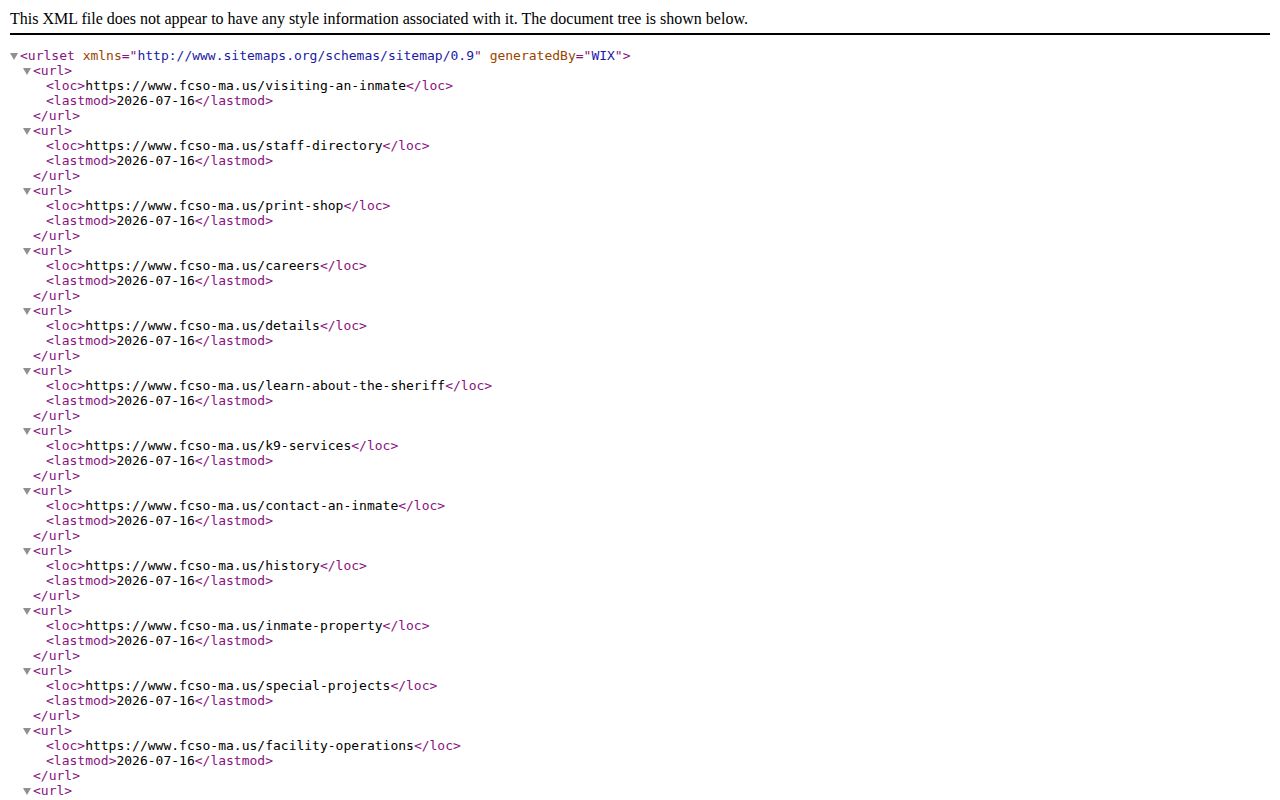
The captured site inventory supports moving directly to the records officer instead of searching for a photo tab that the sheriff does not publish.
This also changes how a recent case should be checked. The Franklin County 24-Hour Release List process uses a date-bounded admission and release record request because no same-day feed exists. A booking photo must be asked for as a separate item. Do not assume it will appear in an admission and release report.
The FCSO Facility Operations page confirms that the records unit keeps committed-person files and prepares admission and release reports. That local record supplies the needed custody context for a separate image.
Request Franklin Booking Photos
Send a focused request to the Franklin County Sheriff's Office when FCSO booked or held the person. The official Records Access page lists records@fcso-ma.us, Franklin County Sheriff's Office, ATTN: Records/Capt. Jason Yuryan, 160 Elm Street, Greenfield, MA 01301, and 413-774-4014 extension 2191. Telephone requests may be accepted at the office's discretion, but a written request creates a clear description of the record sought.
- Give the full name and enough lawful identifying detail to distinguish people with similar names.
- State the approximate booking period, arresting agency, court, docket, or booking number if known.
- Ask for the booking photograph as a separately identified record, preferably in electronic form.
- If release verification is also needed, separately request the actual release date, type, facility, and receiving authority.
- Ask for any segregable public portion and the legal basis for a withheld or redacted part.
M.G.L. c. 66, §10 generally requires a written response within ten business days and provides the framework for production, redaction, estimates, and appeals. That period is a response rule, not a promise that the image arrives in ten days. Electronic records may be free when readily supplied. The sheriff has not published a fixed booking-photo fee, so wait for the custodian's estimate rather than quoting one.
If the arresting police agency kept the image or large booking-related property, route the request there. For a Franklin case housed at the Western Massachusetts Regional Women's Correctional Center, request the regional facility image from Hampden/WCC records. For state prison, use the MA DOC public-record request, which does not cover county jail files.
The FCSO official home page confirms the Elm Street operator and links the local records channels. Use it to verify that a request is going to the actual custodian rather than an unrelated Franklin County in another state.
Franklin Mugshot Disclosure Limits
Massachusetts law resists two simple claims. Booking photographs can be public records, and the photograph alone is not CORI. Yet neither rule says that every photo is always open. The Supreme Judicial Court's 2020 decision in Boston Globe Media Partners, LLC v. Department of Criminal Justice Information Services rejected categorical CORI and privacy withholding for the booking photos at issue. Those images involved arrested public officials and a strong public-interest setting.
The decision must be used in context. It did not create a universal online mugshot gallery or remove all case-specific review. The official 803 CMR 2.00 rules support requesting the image apart from booking-sheet data. A Franklin custodian may still apply a valid exemption or an order that affects access.
- Booking photograph
- The image itself, which Massachusetts regulations say is not CORI by itself.
- Booking sheet
- A record containing arrest and identifying facts that may fall within CORI rules.
- Segregable portion
- The public part of a record that can be produced after protected content is removed.
- Certified release record
- The custodian's record of when and how custody ended, which a photograph cannot replace.
The distinction is practical. Ask for the picture as one item and the custody transaction as another. If one part is restricted, the records officer can assess whether the other is still releasable.
Franklin Mugshot Retention
The Massachusetts statewide retention schedule's J09-02 category describes inmate and detainee central-case-file elements. It includes booking or registration material, mittimus records, warrants or habeas papers, discharge records, property slips, fingerprints, and photographs. The schedule lists fingerprint cards and photographs for permanent retention, with other category material kept for a defined period before electronic handling. The precise application to FCSO's files should still be confirmed with the records officer.
Retention does not equal instant public access. A stored image may require retrieval, identity matching, legal review, or redaction. A photograph retained by police may be held separately from the sheriff's file. Likewise, WCC, MA DOC, or another receiving authority can keep a different identification image from a different custody event.
Local news and official press releases may preserve an image after the booking event. They remain secondary evidence. A caption may omit a later dismissal, plea, sentence, sealing order, or release type. Commercial publishers can also keep stale or mislabeled copies. No commercial mugshot publisher, data broker, or paid removal service is linked or endorsed because those copies are not certified Franklin County custody records.
Note: The photograph identifies a booking event, while the court docket and custodian's release record establish the later legal and custody outcome.
Franklin Mugshots After Expungement
Sealing and expungement are not the same. Sealing restricts public access under the applicable order and law, but it does not support a blanket statement that every operational copy or news image vanishes. Expungement is narrower in eligibility yet broader in its legal treatment of covered government records. M.G.L. c. 276, §100E defines covered records to include arrest, disposition, sentencing, incarceration, rehabilitation, and release records held by courts and government or criminal-justice agencies.
Use the official Massachusetts sealing process or Massachusetts expungement process. After an order issues, ask the court what it covers and ask each originating agency how the order applies to its copy. An empty public portal can reflect sealing, expungement, a search mismatch, or lack of online publication. It does not prove that no booking took place.
No official source in the Franklin research identified a Massachusetts statute that broadly compels a sheriff mugshot gallery or creates a specific statewide pay-to-remove right. Avoid claims that all photos must be posted, must remain open, or must be removed on demand. The order, record holder, and current law control each request.
For a complete event record, pair any available image with the Franklin County released inmate record path. The booking photo proves neither the disposition nor the date custody ended.